
Unifying Trust and Compliance
Zero Trust Access Control in Healthcare Environments
For healthcare security and compliance leaders, “audit-ready” may refer to weeks of frantic log gathering, manual spreadsheet reconciliation and the uneasy hope that nothing was missed. But what if being audit-ready was a continuous state of operations? This is the promise of Zero Trust access control, a foundational architecture that transforms the audit process into a simple verification of an already secure system.
What is Zero Trust Access Control?
In 2026, physical and digital access control in healthcare is increasingly adopting the principles of Zero Trust. It’s a move away from the traditional castle-and-moat model — which assumed everything inside the perimeter is safe — to a posture of “never trust, always verify”. Every access request is continuously validated regardless of its origin. This is important in environments like hospitals, pharmaceutical labs and research facilities, where the convergence of physical and digital security can be a robust foundation for safety and compliance.
Protecting People and Data
Silos between physical security (doors, labs, cabinets) and logical security (IT networks, applications, data) are removed in a Zero Trust framework. Access to any resource — whether a lab or a patient’s electronic health record — is a transaction that must be authenticated, authorized and continuously validated. And so arises the need for a unified identity, where a single credential represents an individual’s permissions across the whole organization. The goal is to create a smart healthcare continuum where security is embedded into every workflow, from the moment a person enters a parking garage to the moment they access a controlled substance in a pharmaceutical cabinet. Unified visibility like this protects against both external attacks and insider threats.
This holistic approach protects people and data in the face of cyberthreats, where a breach of a physical badge could lead to a digital intrusion, and vice versa.
Reducing Friction
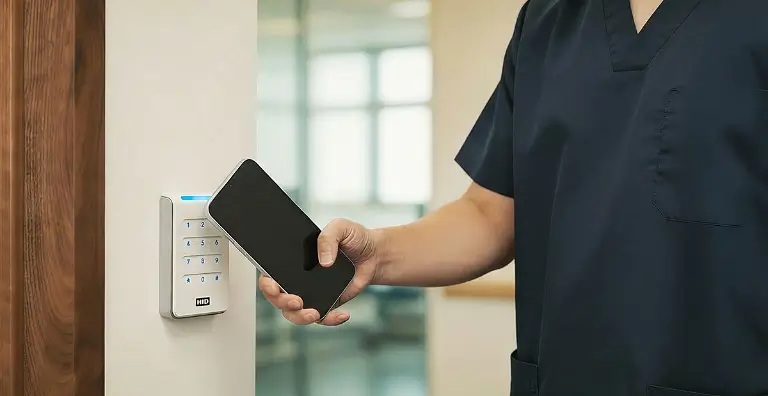
For healthcare, this convergence provides both robust security and rapid, frictionless access for clinicians and researchers. A doctor can use a single badge or biometric identifier to enter a secure ward, unlock a workstation and log into a prescription system.
Besides saving precious time, it ensures that access rights are consistent and centrally managed.
Making Regulatory Compliance Easy
Audit-readiness is a natural outcome of this model as every access attempt is logged and monitored in real time. A detailed, tamper-resistant record is created for compliance with regulations like HIPAA, HITECH and FDA 21 CFR Part 11.
A Unified Approach to Security
HID Global has a portfolio of solutions to enable this single, unified approach to security. Physical and logical access are linked through common credentials. Smart cards serve as both a physical badge for opening doors and a FIDO2-compliant digital credential for passwordless log-in to workstations and cloud applications. Organizations can manage both physical and digital credentials from a single pane of glass, simplifying administration and strengthening security by eliminating passwords.
Continuous, hands-free authentication in sensitive areas is addressed by Seos credential technology, embedded in smart watches or mobile phones. Biometrics provide continuous authentication, ensuring that the user in a cleanroom or lab is who they claim to be throughout their shift.
Where the stakes include patient safety and data integrity, the assumption that insiders can be trusted by default was always a gamble. Moving to continuous verification replaces that gamble with certainty.