

by HID Global • Trevor Human
These are important questions, but they alone rarely determine the project’s success.
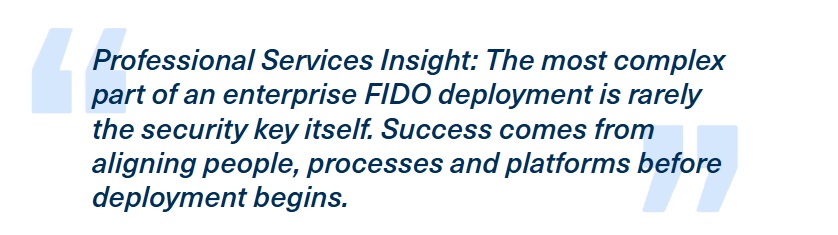
Based on HID Professional Services experience supporting large enterprise deployments, the organizations that achieve the smoothest rollouts are those that invest time in planning long before the first credential is issued. Identity architecture, provisioning workflows, manufacturing requirements, logistics and user onboarding all play a critical role in determining whether a deployment scales successfully.
Recent research from the FIDO Alliance and HID reinforces this point. While 94% of organizations say they are confident they can revoke all physical and logical access within 24 hours when an employee leaves, 35% have experienced delays or failures doing exactly that in the past two years. That gap between confidence and operational reality is a clear reminder that identity programs depend on more than technology alone.
What Is a FIDO Deployment?
A FIDO deployment is the process of implementing FIDO-based authentication, including security keys or passkeys, across an organization. It typically includes credential issuance, identity platform integration, provisioning workflows, user onboarding and credential lifecycle management.
Lesson 1: A Successful Deployment Begins Long Before Production
A common misconception is that implementing passwordless authentication is primarily a technology project. In reality, it is equally an operational and business transformation project.
Every deployment requires a series of decisions that influence everything that follows:
- How will users receive and activate their credentials?
- How will devices be assigned to individual identities?
- How will existing authentication methods coexist during migration?
- Which identity platform requirements need to be accommodated?
- How can today’s deployment support tomorrow’s authentication strategy?
These decisions are typically made months before the first shipment leaves the manufacturing facility, yet they have the greatest impact on the program’s overall success.
Looking Beyond the Credential
Modern security keys and enterprise passkeys provide an intuitive user experience but integrating them into an enterprise identity ecosystem requires considerably more preparation than simply issuing devices.
In one recent deployment, HID Professional Services supported an organization replacing legacy one-time password (OTP) tokens while simultaneously preparing its workforce for future FIDO2 authentication. Rather than viewing these as separate initiatives, the customer adopted a strategy that delivered immediate business value while establishing the foundation for long-term passwordless adoption.
This required close collaboration to define authentication journeys, validate identity platform integration, confirm manufacturing requirements and establish provisioning processes before production could begin.
The Deployment Life Cycle
While every organization follows its own deployment model, enterprise FIDO programs often follow a common life cycle:

Each stage introduces technical and operational considerations that require collaboration across identity, security, IT and operations teams. Manufacturing, provisioning, user onboarding and credential life cycle management decisions made early in the life cycle influence every subsequent phase, making upfront planning one of the most valuable investments an organization can make.
Lesson 2: Planning for Identity Platform Integration for Enterprise FIDO Deployments
One of the most important lessons from enterprise deployments is that the credential itself is only one component of a much larger ecosystem.
Identity platforms often introduce their own provisioning requirements, data formats and operational processes. Ensuring that authentication data generated during manufacturing can be consumed efficiently by the customer’s identity platform is a critical part of deployment planning.
The operational complexity is significant. The same FIDO Alliance and HID study found that 59% of enterprises manage three or more distinct credentials and authentication systems, while 58% say managing digital identity has become more complex over the past two years. For large organizations, this makes integration planning, data preparation and provisioning workflows essential to successfully scaling passwordless authentication.
In the deployment, HID Professional Services worked alongside customer teams and technology partners to validate these workflows, identify integration challenges early and simplify operational processes wherever possible. In one example, automation was developed to transform manufacturing data into a format that enabled bulk import into the customer’s identity platform, simplifying the operational process of onboarding large batches of credentials.
These types of improvements may appear small in isolation, but they become increasingly valuable when programs scale across multiple regions and thousands of users.
Lesson 3: Designing Enterprise FIDO Deployments for Today’s Requirements and Tomorrow’s Strategy
Successful enterprise deployments are designed not only for today’s requirements, but also for tomorrow’s identity strategy.
This future-ready approach is especially important because passkey adoption is still maturing. According to the FIDO Alliance and HID research, 93% of organizations are at some stage of passkey adoption, yet only 13% have deployed passkeys at scale. Early architectural and operational decisions therefore matter, because today’s deployment choices can either accelerate or constrain tomorrow’s passwordless expansion.
Organizations increasingly want credentials that meet immediate operational requirements while supporting future identity strategies. In this deployment referenced here, the initial objective was to replace legacy OTP authenticators, but equal attention was given to ensuring that every credential was prepared for future FIDO2 authentication, including Enterprise Attestation, to strengthen security and give the organization greater control over which authenticators are permitted across the enterprise. By validating the unique identity of each enterprise-issued credential during both provisioning and authentication, the customer established a robust foundation for credential life cycle management, making it simple to replace lost devices, retire existing credentials and ensure that only authorized HID Crescendo Keys remained trusted within the environment.
By confirming relying parties, authenticator attributes and provisioning requirements during the planning phase, the customer established a flexible platform that could support future passwordless initiatives without requiring another credential replacement program.
Future-ready deployments begin with future-ready decisions.
Technology Alone Doesn’t Deliver Successful Rollouts
Technical implementation is only one component of a successful enterprise passwordless authentication deployment.
Large organizations must also coordinate manufacturing schedules, packaging, regional distribution, device compatibility, communications and stakeholder alignment across multiple business units and geographic locations.
Professional Services plays an important role in connecting these activities, helping technical teams, project managers, manufacturing specialists and customer stakeholders work towards a shared deployment plan. This coordination helps reduce project risk while ensuring technical implementation remains aligned with business objectives.
Key Lessons Learned
Our experience supporting enterprise identity modernization programs continues to reinforce several important principles:
- Successful FIDO deployments begin with planning, not production
- Identity platform integration deserves as much attention as credential selection
- Building future FIDO capabilities into today’s deployment reduces long-term complexity
- Operational readiness, including provisioning, logistics and user onboarding, is essential for large-scale success
- Professional Services delivers value by connecting technology, people and program governance into a single, coordinated deployment strategy
Final Thoughts
Passwordless authentication is about far more than replacing one credential with another. It is an opportunity to modernize identity, strengthen security and create a better user experience. This only works when the foundations are established correctly.
The most successful enterprise deployments are built on careful planning, cross-functional collaboration and a clear understanding of both today’s operational requirements and tomorrow’s strategic goals.
By investing in these early stages of deployment, organizations can reduce implementation risk, accelerate adoption and create a scalable foundation for future converged access and passwordless authentication initiatives.
Planning a FIDO2 or passwordless authentication rollout? Explore how HID Professional Services can help you prepare the right foundation before deployment begins.
Frequently Asked Questions
1. What is a FIDO deployment?
A FIDO deployment is the process of introducing FIDO-based authentication, such as security keys or passkeys, into an enterprise environment. This typically includes selecting credentials, integrating with identity platforms, defining provisioning workflows and preparing users for passwordless authentication.
2. Why is planning important for enterprise FIDO deployments?
Planning helps organizations align technology, people and processes before credentials are issued. By defining identity platform requirements, provisioning workflows, logistics and onboarding steps early, enterprises can reduce deployment risk and make it easier to scale passwordless authentication across large user populations.
3. How can HID Professional Services support a passwordless rollout?
HID Professional Services can help enterprises prepare for successful passwordless rollouts by supporting deployment planning, identity platform integration, manufacturing and personalization requirements, provisioning processes and stakeholder coordination across technical and operational teams.
4. How do passkeys fit into a FIDO deployment?
Passkeys are FIDO-based authenticators that help organizations reduce reliance on passwords. Many enterprises deploy credentials today that support future passkey adoption as part of a broader passwordless authentication strategy.
5. What challenges do organizations face when deploying FIDO authentication at scale?
Organizations often encounter challenges related to identity platform integration, credential provisioning, user onboarding, logistics and credential life cycle management. Addressing these areas during planning helps reduce deployment complexity.
6. What is the difference between a FIDO security key and a passkey?
A FIDO security key is a physical authenticator used for passwordless and phishing-resistant authentication. A passkey is a FIDO credential that may be stored on a device, security key or platform authenticator and used to sign in without a password.