
While we’ve seen more customers migrate to cloud-based offerings, it’s still common to encounter misconceptions about what cloud identity management is, how it works and what options are available. Even those with a baseline understanding of the cloud may be fuzzy on how it applies to issuing physical ID cards. This is understandable, given the sensitivity of the data involved. So let’s clear things up.
Cloud Identity Management: The Basics
In the simplest terms, cloud computing, or “the cloud,” is the web-enabled delivery of computing services that can be accessed via the internet. These services may include applications and the underlying technologies that support them, such as operating systems, middleware, data storage, servers and networking.
To put it in relatable terms: do you stream movies or TV shows at home? Do you create and share documents using Microsoft 365 at work? If so, you’re already using cloud technology. Most of us use the cloud all day without realizing it, but the benefits are hard to miss. We’re free from downloading or managing software, our information syncs across devices automatically, and we can access everything from a phone, laptop or tablet from anywhere. The flexibility is remarkable.
In a cloud services model, often called Software as a Service (SaaS), providers host some or all of their customers’ applications and systems. Maintenance and management are offloaded to the provider, saving customers time and money and freeing up resources for higher-priority work.
What Is Cloud Identity Management?
Cloud identity management takes this a step further. It’s the practice of managing who has access to what, across physical and digital environments, through cloud-based platforms. That includes issuing, tracking and revoking identity credentials such as ID cards, all from a centralized system accessible via the internet.
For organizations that issue physical ID cards, cloud identity management means the entire issuance workflow — card design, record management, encoding and printing — can now be handled remotely, without a dedicated PC tethered to a printer.
What About On-Premises Cloud Solutions?
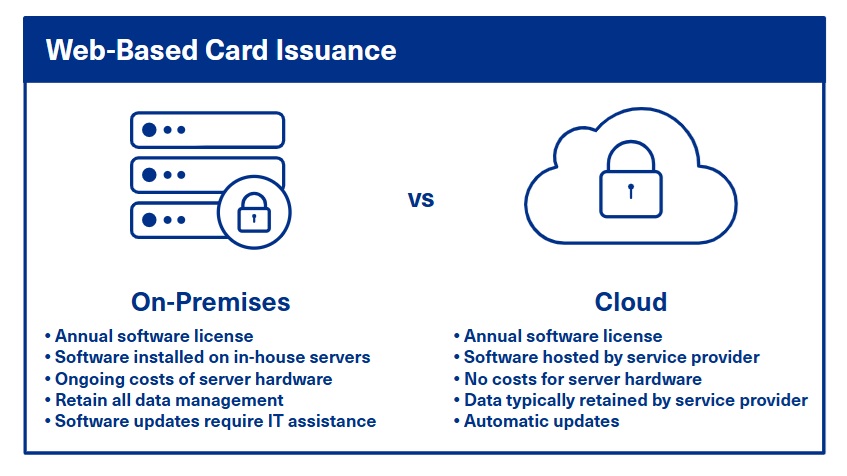
Not every organization is ready or able to move to a fully hosted cloud model, and that’s where on-premises cloud solutions come in. This approach still delivers the flexibility benefits of the cloud, like browser-based access and synced data, but the servers are managed by the customer rather than the provider. Because the solution lives on the customer’s own servers, users generally need to be on their company’s network to access it. For identity management purposes, it’s a useful middle ground: organizations retain control over their infrastructure while still gaining many of the operational efficiencies cloud platforms offer.
How Does Cloud-Based ID Card Issuance Work?
Traditionally, creating an ID card starts with a PC connected to a card printer within arm’s reach. The process includes designing a card template, managing records via a networked database and sending the job to the printer. With true cloud-based platforms, that entire process can now be managed remotely without a dedicated PC.
With a cloud-based model, everything required for secure ID card issuance lives in a centralized, integrated system accessible via the internet. Administrators at a main campus, satellite facility or home office can create new cards (including smart data encoding during the print process), issue replacements and manage print queues — all from a tablet, laptop or any web-enabled device. The scalability is particularly impressive: users can add or remove devices without ever installing software, including the cumbersome Windows® print drivers that often require frequent updating.
What Should I Look for in a Cloud-Based ID Card Issuance Solution?
First, look for seamless integration with the systems from which your ID card data is pulled. When your identity management platform and your card issuance platform communicate natively, card office complexity drops, as operators no longer have to toggle between a record management application and a separate issuance tool. Organizations gain process efficiencies, reduce program costs and can scale more easily as technology or volume demands change.
Beyond integration, prioritize solutions with a multi-layered approach to security. Most secure cloud products rely solely on a Transport Layer Security (TLS) connection. However, industry-leading solutions like HID FARGO Connect go further by combining TLS communication with mutual TLS authentication and end-to-end asymmetric RSA encryption. That multi-layered approach ensures cardholder data is protected both in transit and at rest.