
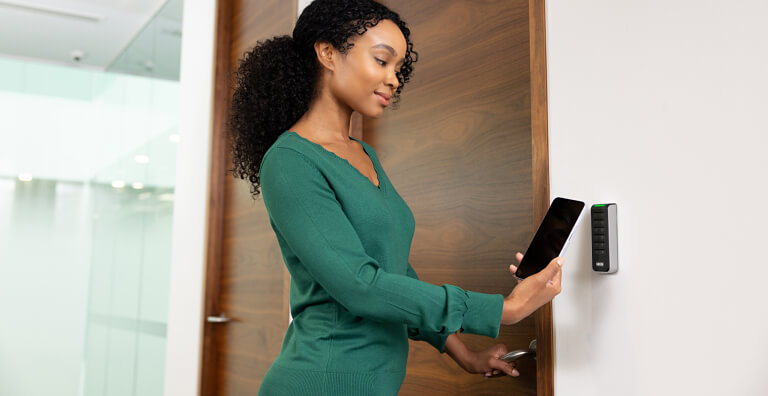
The access control market is undergoing a dynamic transformation driven by digitalization, mobility and growing security requirements. Not long ago, plastic proximity cards were the standard; today, they are increasingly being replaced by mobile credentials — digital identifiers stored on smartphones or smart watches. The pace of this change is strongly influenced by the widespread adoption of contactless payments such as Apple Pay and Google Pay.
Mobile credentials combine convenience, security and flexibility. Users no longer need a physical card — only the device they always carry with them. Access is contactless, using NFC or Bluetooth® Low Energy (Bluetooth LE) technology, enabling fast and secure authentication. Such solutions are particularly attractive in corporate environments, universities and multi-tenant office spaces, where a smooth, intuitive user experience is becoming a hallmark of innovation and workplace or facility appeal.
Migrating from traditional cards to mobile solutions is a natural step toward the integration and digitalization of security processes. Mobile access not only enhances user convenience but also significantly simplifies credential life cycle management — issuance, revocation, or modification can all be done remotely, without printing or distributing cards. This means not only time and cost savings but also a reduction in plastic waste. Organizations also eliminate expenses associated with card personalization, including the purchase, maintenance and servicing of card printers and consumables.
Another key advantage of mobile credentials is their higher level of security. Unlike legacy proximity cards (e.g., 125 kHz) or older 13.56 MHz cards with outdated encryption, which can be easily cloned, digital credentials use advanced encryption and can require additional user authentication such as a PIN, fingerprint or facial recognition. This creates a multi-factor authentication by default access control system — even when using simpler, lower-cost readers without keypads or biometric modules. A mobile device can store multiple credentials simultaneously — not only for door access but also for printers, lockers, elevators, EV-chargers, PC-logon and many other uses.
Another step forward involves credentials stored in Apple Wallet and Google Wallet. User data is protected in a hardware-isolated secure element, the same chip that safeguards payment cards. Each interaction is encrypted and could be protected by biometrics or PIN (MFA-by-default). Access is instant — users simply hold their phone near an NFC reader, without needing to open an app or activate Bluetooth. Compared to Bluetooth LE-based solutions, which often require launching an app and establishing a connection, wallet-based access offers greater reliability and ease of use.
However, implementing mobile solutions often requires upgrading existing infrastructure. Readers must support NFC or Bluetooth LE protocols — fortunately, most HID readers sold between 2018 and 2025 support one or both. When system modernization or reader replacement is necessary, organizations increasingly opt for open communication standards such as Open Supervised Device Protocol (OSDP), recommended by the European and international standard (IEC 60839) for alarm and electronic security systems. This ensures compatibility with various vendors and enables ongoing technological development without being locked into a single manufacturer.
Sustainability aspects are also gaining importance. Eliminating plastic cards and managing credentials centrally helps reduce carbon footprints, aligning with the environmental, social and governance (ESG) policies adopted by a growing number of companies. In this context, mobile technology is becoming not only more modern but also more responsible.
The transformation toward mobile credentials is therefore inevitable. Although many organizations still rely on traditional cards, more and more are preparing for the full digitalization of access. This trend is supported by the development of mobile infrastructure, the popularity of contactless payments such as Apple Pay and Google Pay, growing security awareness, and the need to create smarter and more flexible work environments. As a result, the smartphone — once merely a communication tool — is now becoming the key to buildings, offices and shared spaces.
Learn more about HID’s mobile access solutions or contact one of our experts >>